Osaka

Osaka is the biggest city in the Kansai region. By train, it takes about 30min to get there from Kyoto.
Osaka is the biggest city in the Kansai region. By train, it takes about 30min to get there from Kyoto.

I finally visited Kyoto (as well as Osaka and Nara) this week.
I took the Shinkansen in Tokyo on Monday morning and arrived a bit more than 2 hours later in Kyoto. I walked from the train station to Sanjusangendo Temple and its 1000 statues of Kannon. Then I continued to Kiyomizudera Temple. Part of it is currently undergoing renovation so I could not visit all the buildings. I walked for a bit in the area (known as Higashiyama) and visited the Ryozen Kannon war memorial as well as the Kodai-ji Temple and its zen garden. I then made my way to the Yasaka Shrine and then on to the huge Heian Shrine. After that, I took the bus to Ginkaku-ji Temple (“Temple of the Silver Pavilion”). Not having reached temple overload yet, I ended the day at Kinkaku-ji Temple (“Temple of the Golden Pavilion”). Contrary to the Silver Pavilion (not actually covered in silver), this one is indeed plated with gold leaf. I then went back to my hotel, near Kyoto train station.

After Yugawara, I stopped at the nearby Cape Manazuru, a small peninsula protruding into Sagami Bay. Apparently, its shape resembles a crane with open wings. At the tip of Cape Manazuru, there is a distinctive rock formation called “Mitsuishi” (三ツ石; Three Rocks). There are also trails in the forest near the rock but I didn’t have time before nightfall. To get there, I took the bus from Manazuru station to the tip of the peninsula and walked down to the ocean and the Mitsuishi rocks then went back to the station by bus.
Above, Cape Manazuru seen from Mount Nango.

Hotel Chinzanso Tokyo is a five star hotel in Bunkyo. It also has a large garden open to the public. I went there at the beginning of march in the evening, then again at the end of the month, during peak blossom in the morning.
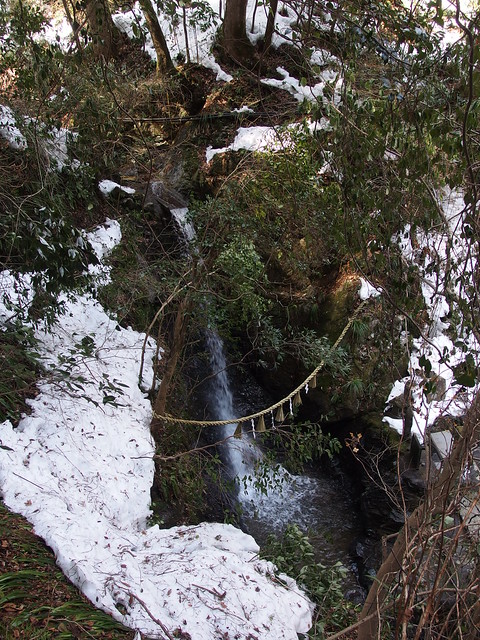
Mount Takao has many trails to and from the summit. This time, starting from the Takaosanguchi Keio station (高尾山口駅) at the foot of the mountain, I took trail #6 to get to the summit. There was still a lot of snow left. On the way down, I started on trail #3 then followed the paved road (trail #1) until Konpiradai, where I took a trail through the forest. I then walked to the Takao JR station, in town.

The Tenen Hiking Trail connects Kenchoji Temple in Kita-Kamakura with Zuisenji Temple in the east of the city, leading mostly along the ridge of the hills. I had come back to Kamakura intending to do the 3 hiking trails listed on that page but it was not great because of the melting snow that made the trail very muddy. I ended the day in Enoshima instead.

Mukojima-Hyakkaen Garden in Sumida City is the only surviving flower garden from the Edo Period in Tokyo. There currently is a plum festival to celebrate the blossoms of the many plum trees in the garden.

The day after the snowstorm,/ I went to the Hamarikyu Garden. The snow was already melting.

The Tokyo University of the Arts in Ueno is one of the oldest art schools in Japan. For one week at the end of January, they opened their doors to the public for an exhibition of the works of the graduating students.
